
Maeve’s CDH Story
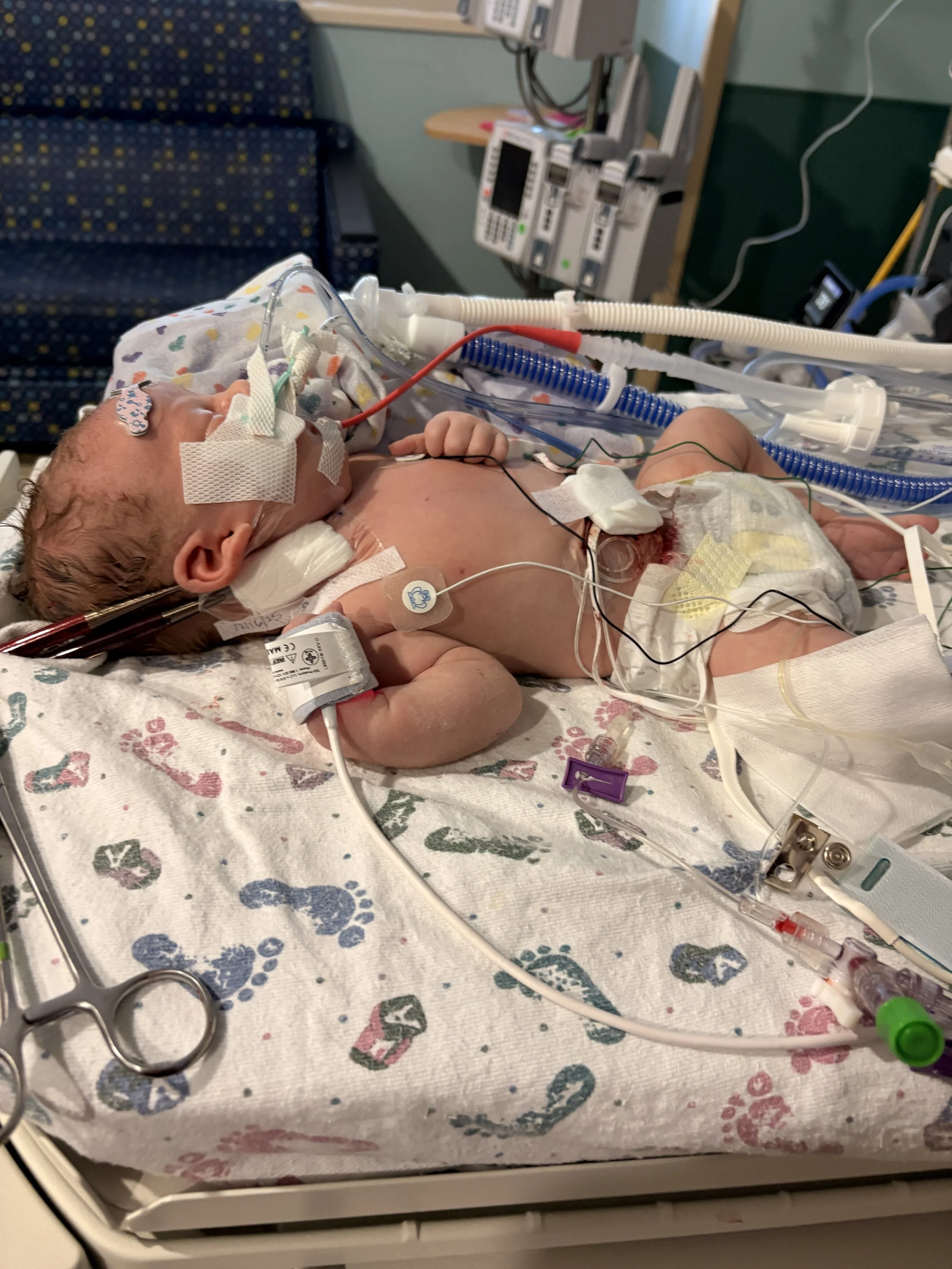
At 14 weeks pregnant, we found out that our daughter, Maeve, had congenital diaphragmatic hernia (CDH). We were only at the appointment because Maeve had been diagnosed with Turner syndrome. During the ultrasound, we learned that her heart had shifted to the right side of her chest, and her stomach and spleen had already moved up into her chest.
We returned for her 20-week anatomy scan to confirm the diagnosis and have an amniocentesis. Once we knew Maeve had CDH, we immediately began researching the best place for her care. We learned about Johns Hopkins and were referred to Dr. Kays. After navigating insurance issues and countless hurdles, we finally had our appointment.
We quickly realized Maeve’s CDH was going to be much more severe than we had hoped.
While many families leave their first appointment with encouraging survival statistics, our appointment was filled with fear and uncertainty. Maeve had almost every abdominal organ in her chest. She had a hiatal hernia, which allowed her organs to move across the diaphragm and fill both sides of her chest. Both kidneys, her spleen, stomach, bowels, and liver had moved into her chest.
Her left lung was so small and compressed by the organs around it that the doctors could barely see it. There was also concern about a possible coarctation of her aorta, another complication associated with Turner syndrome.
Dr. Kays gave us a 60–70% survival estimate. Maeve had a 100% likelihood of needing ECMO and less than 7% lung volume. We were told to prepare for a NICU stay that could last six to eight months.
We scheduled a C-section and made the difficult decision to relocate to Florida so Maeve could be born close to the team who would care for her.
Maeve was born on December 16th.
As expected, she was placed on ECMO shortly after birth. She tolerated it as well as she could, and the following morning, the surgical team repaired her CDH.
During surgery, we learned just how severe her condition truly was. Maeve was missing 95% of her diaphragm. She had only 5% of her left lung, and her right lung was also extremely small.
The doctors expected Maeve to need ECMO for at least a month.
But Maeve had other plans.
She amazed everyone with how well she tolerated ECMO and was able to come off after just 20 days. The doctors expected her to remain intubated for quite some time after that, but Maeve continued to surprise us. Just one week later, she was extubated.
She quickly weaned from CPAP and made it to a nasal cannula just a few days later.
Our next challenge came when we began working on feeds. Maeve had severe reflux and struggled to keep anything down. An upper GI showed that she had a hiatal hernia, a dilated esophagus, and significant reflux. She eventually needed a Nissen fundoplication and G-tube and is now primarily G-tube fed as we continue working on increasing her feeds.
After everything we had been told to prepare for, Maeve spent just 80 days in the hospital.
Today, Maeve is eight months old and happily home in Oklahoma.
She continues to face challenges and delays related to the severity of her CDH, her time on ECMO, Turner syndrome, and her long hospital stay. But despite everything she has been through, Maeve is the happiest little girl.
From the very beginning, Maeve has shown us that she is stronger than the numbers, stronger than the predictions, and stronger than we ever could have imagined.
We were told to prepare for the worst. Instead, Maeve gave us hope.
She is our tiny hero.